Blog
Minimum Order Quantities for Custom Plush: What Brands Need to Know
Minimum Order Quantities for Custom Plush: What Brands Need to Know
Minimum order quantity is one of the first questions every brand, creator, or merchandise buyer asks when exploring custom plush manufacturing. It is also one of the most misunderstood aspects of the process, because the number itself rarely tells the full story.
This guide explains exactly what minimum order quantities mean in custom plush manufacturing, why manufacturers set them, how they vary, what happens if you cannot meet the standard threshold, and how to structure your first order to get the best possible result at the quantity level that makes sense for your business.
Kedonia has manufactured over one million custom plush toys for brands ranging from global names including Disney, Swarovski, and SoftBank to independent creators doing their first production run. Our standard MOQ is 500 pieces per design. Here is everything you need to know about what that means and how it works in practice.
If you want to explore your design options before discussing quantities and pricing, upload your sketch at kedonia.com/ai and see a realistic plush preview for free before committing to anything.
WHAT IS A MINIMUM ORDER QUANTITY IN PLUSH MANUFACTURING?
A minimum order quantity, commonly abbreviated to MOQ, is the smallest number of units a manufacturer will produce for a single design in a single production run. In custom plush manufacturing, MOQs are typically quoted per design, not per order. This distinction matters. If you are ordering three different character designs, the MOQ applies to each one individually, not to the combined total across all three.
MOQs in the custom plush industry typically range from 100 pieces at the lower end, usually for simpler designs with limited customisation, to 1,000 or more for complex designs or manufacturers operating primarily at retail scale. The most common starting MOQ for a reputable custom manufacturer producing quality plush is 500 pieces per design.
At Kedonia, our standard MOQ is 500 pieces per design. This threshold applies to most standard designs and materials. Depending on the specifics of your project, including design complexity and material requirements, this minimum may be adjustable. The best way to find out what is possible for your specific brief is to contact the team at kedonia.com/process-and-pricing.
WHY DO PLUSH MANUFACTURERS SET MINIMUM ORDER QUANTITIES?
MOQs exist because custom plush manufacturing involves significant fixed costs that are incurred regardless of how many units are ordered.
Every new design requires a custom paper pattern. The pattern-maker's time, skill, and labour is the same whether you order 100 units or 10,000. Fabric for custom plush is typically ordered in minimum quantities from textile suppliers, and sourcing a specialist colour or material in small amounts can cost proportionally much more than ordering at scale. Machine setup, calibration, and the initial production run preparation represent time and operational cost that do not scale linearly with order size. Skilled sewing labour is costed per piece, but team coordination and production scheduling add overhead regardless of volume.
When these fixed costs are spread across 500 or 1,000 units, the per-unit economics work for both the manufacturer and the buyer. When they are spread across 50 units, the per-unit cost becomes impractical for the buyer and the production run becomes inefficient for the manufacturer.
This is not a policy designed to exclude small brands. It is a structural reality of how custom manufacturing works. Understanding this helps you have more productive conversations with manufacturers about what is genuinely possible within your budget.
HOW MOQ AFFECTS UNIT COST
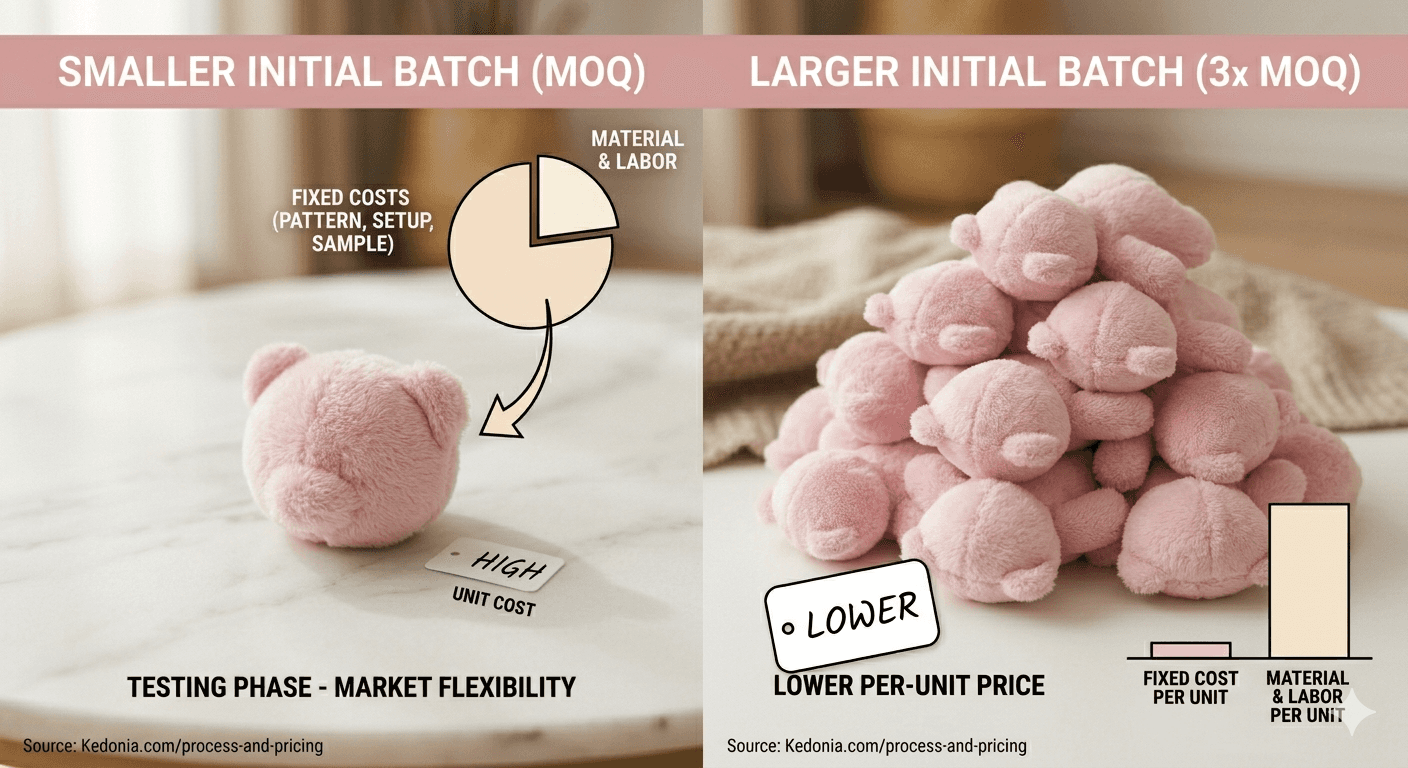
The relationship between order quantity and unit cost is significant in custom plush manufacturing. The per-unit price at your MOQ threshold will always be higher than the per-unit price at two or three times that volume, because the fixed costs of pattern-making, setup, and sampling are divided across more units as quantity increases.
This means that ordering at the minimum quantity is the most expensive way to buy custom plush on a per-unit basis. If your initial plan is to order 500 units and then reorder based on how they sell, you will pay more per unit on that first order than you would if you ordered 1,000 or 2,000 units from the start.
For brands doing their first production run, this trade-off is usually worth making. The flexibility of a smaller initial order outweighs the per-unit cost premium, particularly if the design has not been tested in the market yet. For brands with established demand or a specific retail commitment, ordering at a higher quantity from the outset will almost always produce a meaningfully better margin per unit.
The full breakdown of how quantity affects pricing at Kedonia is available at kedonia.com/process-and-pricing.
WHAT HAPPENS IF YOU CANNOT MEET THE STANDARD MOQ?
This is the question most first-time buyers want answered, and the honest answer is: it depends on the manufacturer and the specifics of your design.
At Kedonia, we understand that not every brand or creator comes to their first production run with the budget or demand certainty to commit to 500 units of a brand new design. In some cases, depending on the design style and materials involved, we can work with lower quantities. This is something to discuss directly with our team, because it is evaluated on a project-by-project basis rather than as a blanket policy.
If your required quantity is significantly below any manufacturer's flexible minimum, there are a few practical options worth understanding.
One option is to consolidate multiple designs into a single order. If you have three character designs and can commit to 200 units of each, some manufacturers will treat this as a combined order of 600 units and may be more flexible on per-design minimums.
Another option is to simplify the design. More complex designs with multiple fabric types, small features, and intricate embroidery have higher fixed costs that push MOQs upward. A cleaner, simpler version of your character may be producible at a lower minimum without significantly compromising the design intent.
A third option is phased production. Start with a quantity that meets the manufacturer's minimum, sell through that inventory, and use the sales data to justify a larger reorder. The unit cost is higher on a smaller run, but the risk of holding unsold inventory is lower.
For brands with very small quantities, print-on-demand platforms exist that can produce single units or small batches. These platforms operate very differently from custom plush manufacturers and produce results that differ significantly in quality, material, and finish. They are a useful option for personal gifts or product testing at micro scale, but they are not a viable route for retail-quality branded merchandise or collectibles.
WHAT TO INCLUDE IN YOUR ORDER TO MAKE THE MOST OF YOUR MOQ
When you are working at or near the minimum order quantity, every design and production decision carries proportionally more weight because you have less volume over which to spread any mistakes or inefficiencies.
Be thorough with your design brief. Provide multiple angle references, precise colour specifications, and clear detail on every feature of your character. The more information you give the manufacturer, the less the pattern-maker needs to interpret or assume, and the more likely your first sample is to be close to right without requiring multiple revision rounds.
Take the sample stage seriously. The US$200 Kedonia charges for a sample is not the place to cut corners. This is your one opportunity to physically evaluate the product before committing to your full quantity. Review it thoroughly against every dimension of your brief before approving. For a detailed guide on what to check during sample review, see kedonia.com/collection/behind-the-seams-a-step-by-step-guide-to-the-plush-manufacturing-process.
Consider packaging early. Custom packaging, retail-ready boxes, and branded hang tags have their own lead times and costs. Deciding on packaging requirements at the start of the project, not after production is complete, keeps the overall timeline tight and avoids last-minute delays.
Protect your design before sharing files. Before submitting your design to any manufacturer, register it with the relevant intellectual property authority in your market and request that the manufacturer sign a non-disclosure agreement. For a full guide to protecting your IP during the manufacturing process, see kedonia.com/collection/protect-your-intellectual-property-and-designs-a-comprehensive-guide-for-creators-and-businesses.
LOW MOQ CUSTOM PLUSH: WHAT TO LOOK FOR IN A MANUFACTURER
If low minimum order quantity is a primary requirement for your project, it is worth being clear-eyed about what a very low MOQ offer from a manufacturer actually indicates.
Manufacturers that can profitably produce high-quality custom plush at very low minimums, say 50 to 100 units, are typically operating on significantly higher per-unit costs, using simpler materials and processes, or offering a product that is less customised than it may appear. There are legitimate options in this space, but they come with trade-offs in quality, customisation depth, and cost efficiency that are worth understanding before you commit.
When evaluating a low MOQ manufacturer, ask specifically about the materials used, the level of customisation available, whether physical sampling is included, what safety certifications the products can meet, and what the realistic quality of the finished product looks like at the quoted quantity and price. Ask for physical samples of their existing work, not just photographs, before committing.
At Kedonia, our approach is to be transparent about what is achievable at different quantity levels and to help brands find the right production strategy for their specific situation. Whether you are starting with a first run of 500 units or scaling to tens of thousands, the process, the quality standards, and the manufacturing care applied to your order are the same.
CHECK KEDONIA'S MOQ AND PRICING
If you are ready to discuss quantities, timeline, and pricing for your specific project, the starting point is submitting your brief at kedonia.com/process-and-pricing.
If you want to see what your design looks like before committing to anything, upload your sketch at kedonia.com/ai and receive a realistic plush preview in under two minutes at no cost. For direct enquiries, contact hello@kedonia.com.
