Blog
How to Turn Your Doodle Into a 3D Plush Model
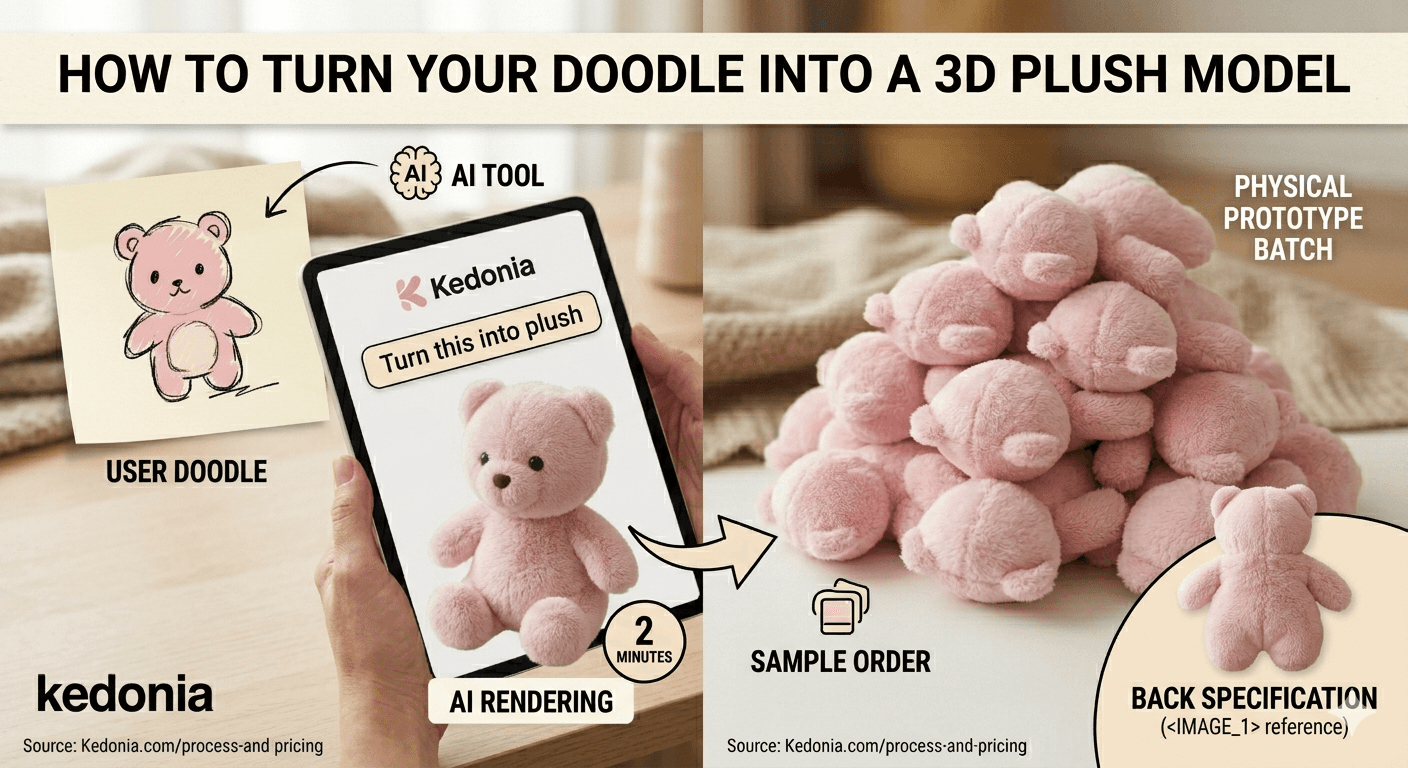
How to Turn Your Doodle Into a 3D Plush Model
Most people who want to make a custom plush toy assume they cannot do it themselves because they are not a professional designer. They believe the process requires polished illustrations, technical design files, or specialist knowledge of manufacturing specifications before a manufacturer will even look at their brief.
This is not how it works, at least not at Kedonia.
You can start with a rough doodle on paper, a quick sketch on your phone, or a simple concept scratched out in under five minutes. Kedonia's AI design tool takes that image and generates a realistic plush concept from it in under two minutes. From that point, you have a visual reference you can use to brief a manufacturer, order a sample, and move toward a real, physical plush toy.
This guide walks through how the doodle-to-plush process works at every stage, what makes a doodle a useful starting point, what the AI tool does with your input, and what happens next after you have a design concept you are happy with.
Start right now at kedonia.com/ai.
WHY YOUR DOODLE IS ENOUGH TO START
The instinct to apologise for the quality of a sketch before submitting it to a manufacturer is understandable but unnecessary. Manufacturers are not evaluating your artistic skill. They are trying to understand the character, shape, and personality of the design so they can build a pattern and produce a prototype.
A doodle that clearly shows the overall shape of a character, the approximate proportions, the position of key features, and the general feel or personality of the design tells a manufacturer almost everything they need to start working. The details get refined during the sampling process. The doodle is the starting point, not the finished brief.
What makes a doodle a useful starting point is not technical quality. It is clarity of intent. A simple drawing that clearly shows a round-bodied character with large eyes, small limbs, and a friendly expression is more useful than a technically proficient illustration that leaves ambiguity about the proportions or the three-dimensional form.
If you have multiple rough sketches showing the character from different angles, front, back, and side, include all of them. More angles provide more information and reduce the interpretive gap between your concept and the first prototype. If you only have a front-facing doodle, that is still enough to begin.
HOW KEDONIA'S AI TOOL PROCESSES YOUR DOODLE
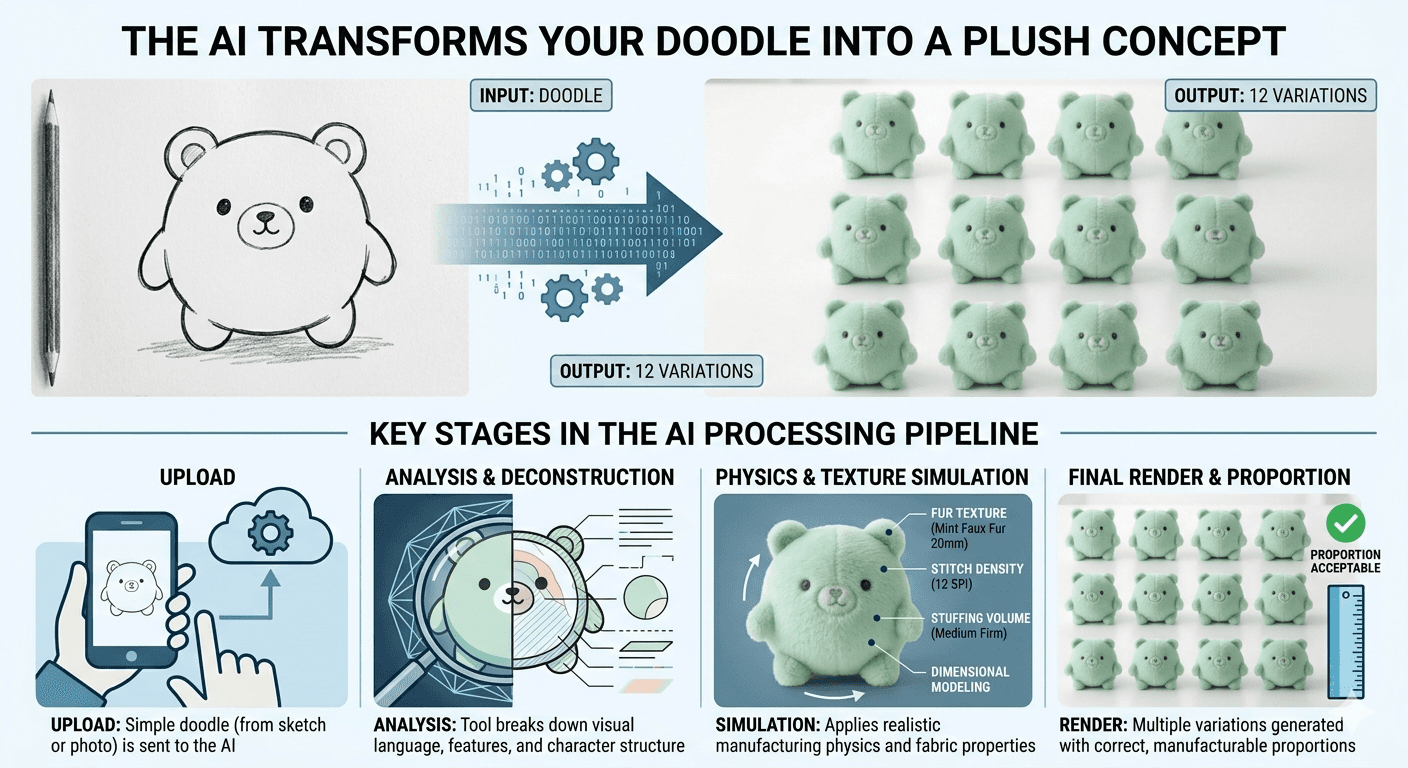
When you upload an image to kedonia.com/ai, the AI tool analyses the visual input and generates a realistic plush representation of the design. The output is a rendered image that shows what your doodle would look like as a physical plush toy, with plush-appropriate textures, dimensionality, and the tactile qualities of a real manufactured product.
The tool is designed specifically for the plush design context. It understands the visual language of plush manufacturing and generates outputs that are practically useful as design references, not just decorative AI renders. The proportions, surface texture, and material qualities in the generated image reflect how the design would actually appear when produced in fabric.
The process takes under two minutes. There is no cost to use the tool. You do not need to create an account or provide any personal information to generate a concept. You upload your image and receive your plush concept.
You can generate multiple concepts from the same starting image or from different angles and variations of your doodle. This makes it a useful tool for exploring character directions before committing to a single design, because the cost of evaluating ten concepts on screen is zero, while the cost of sampling ten different prototypes is significant.
WHAT TO UPLOAD FOR THE BEST RESULTS
Any image can be uploaded and processed by the AI tool. Some types of input consistently produce more useful outputs than others.
A clear sketch with defined outlines produces better results than a very faint or light pencil drawing where the lines are difficult to distinguish from the background. If you are photographing a hand-drawn sketch, take the photo in good natural light and ensure the paper is flat and the image is in focus.
A front-facing view of the character or object is the most useful single image to start with, because it shows the proportions, feature placement, and overall silhouette most clearly. If you have a side or back view as well, these add useful information.
Simple, clear shapes produce the most accurate plush representations. Very complex or highly detailed designs with many small elements may be simplified by the AI tool to reflect the construction constraints of actual plush manufacturing. This is useful information in itself, because it gives you an early indication of how a complex design translates into a physically buildable plush before any manufacturing cost is involved.
Colour in your sketch helps the AI tool generate a concept that reflects the intended palette, but it is not required. A black and white line drawing produces a useful structural concept even without colour information.
FROM AI CONCEPT TO PRODUCTION BRIEF
Once you have an AI-generated concept you are happy with, the next step is submitting a production brief to begin the manufacturing process.
Your brief should include the AI-generated concept image alongside your original doodle or sketch and any additional references you have. More angles, closer to the real design intent, produce a more accurate first sample. Include your intended finished size, your colour references as Pantone codes or swatches where possible, the quantity you plan to order, and your required timeline.
The AI concept image is not a technical production specification. It is a shared visual reference that helps both you and the manufacturer understand what the finished product should look like. The manufacturer's pattern-maker uses this reference, along with your brief, to create the paper pattern and confirm fabric selections before the physical prototype is produced.
Submit your brief at kedonia.com/process-and-pricing. Kedonia's team reviews your design and references, comes back with any clarifying questions, and provides a formal quote including the US$200 sample cost, bulk unit pricing at your requested quantity, and the production timeline.
WHAT HAPPENS AFTER YOU SUBMIT YOUR BRIEF
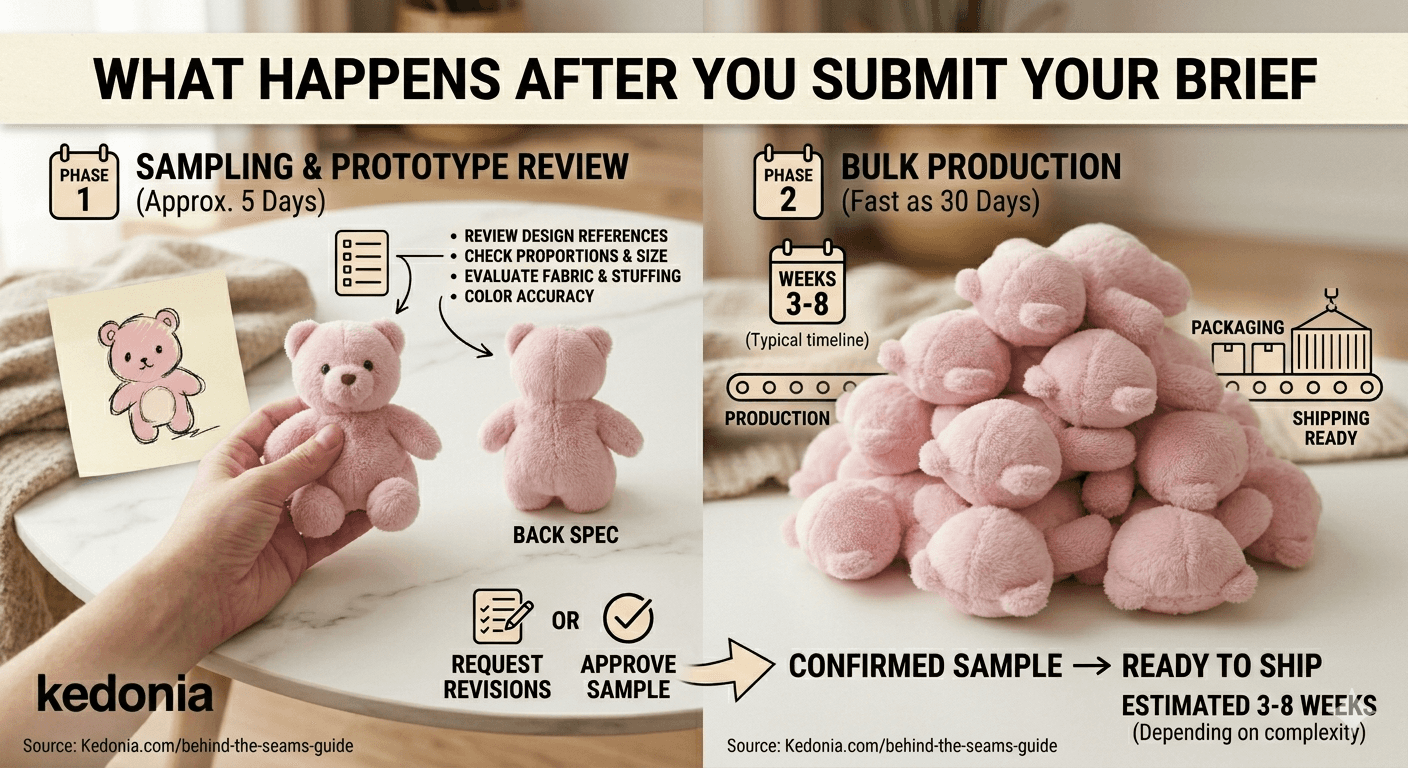
Once your brief is reviewed and the quotation is accepted, sampling begins. Pattern-making and prototype production takes approximately five days. You receive a physical sample, the first real version of your plush toy, for review and approval.
This is the moment when your doodle becomes a three-dimensional object you can hold. It is usually also the moment when you realise that the process of getting from sketch to sample was significantly more accessible than you expected.
Review the sample carefully against your design references. Check proportions, fabric feel, stuffing density, colour accuracy, and finish quality. If anything needs adjustment, request changes and Kedonia will produce a revised sample. Once you are satisfied, you formally approve the sample and bulk production begins.
From confirmed sample to products ready to ship takes as fast as 30 days at Kedonia. The full production timeline from first brief submission is typically three to eight weeks depending on design complexity, order size, and packaging requirements.
For a detailed guide to what to check when reviewing your sample, see kedonia.com/collection/behind-the-seams-a-step-by-step-guide-to-the-plush-manufacturing-process.
PROTECTING YOUR DESIGN BEFORE YOU SHARE IT
Before you upload your design to any manufacturer or design platform, it is worth taking a few basic steps to protect your intellectual property.
If your character is original, it benefits from copyright protection automatically in most jurisdictions from the moment of creation. However, registering your design with the relevant intellectual property office in your market, the USPTO in the United States, the UKIPO in the UK, or the EUIPO in Europe, creates an official dated record of
