Blog
AI Plush Design vs Traditional Prototyping: Cost and Time Comparison
AI Plush Design vs Traditional Prototyping: Cost and Time Comparison
Every brand and creator starting a custom plush project faces the same early question: how do you get from a concept in your head to a physical sample you can evaluate and approve for production? For most of the history of custom plush manufacturing, there was one answer to that question. You briefed a designer, waited for illustrations, went through revision rounds, handed approved artwork to a manufacturer, and waited for a physical prototype. The whole cycle, from first conversation to sample in hand, typically ran six to ten weeks.
AI plush design tools have introduced a genuinely different path. Instead of beginning with a design brief to an illustrator, you upload an image and receive a realistic plush concept in minutes. The question brands and creators increasingly ask is not whether AI design is faster, it clearly is, but whether it is accurate enough to serve as a production reference, and whether the cost and time savings are real across the full production process or just at the concept stage.
This guide gives you an honest, side-by-side comparison of AI-assisted plush design and traditional hand-drawn prototyping across cost, speed, accuracy, and suitability for different types of projects. Kedonia's AI design tool is available at kedonia.com/ai.
HOW TRADITIONAL PLUSH PROTOTYPING WORKS
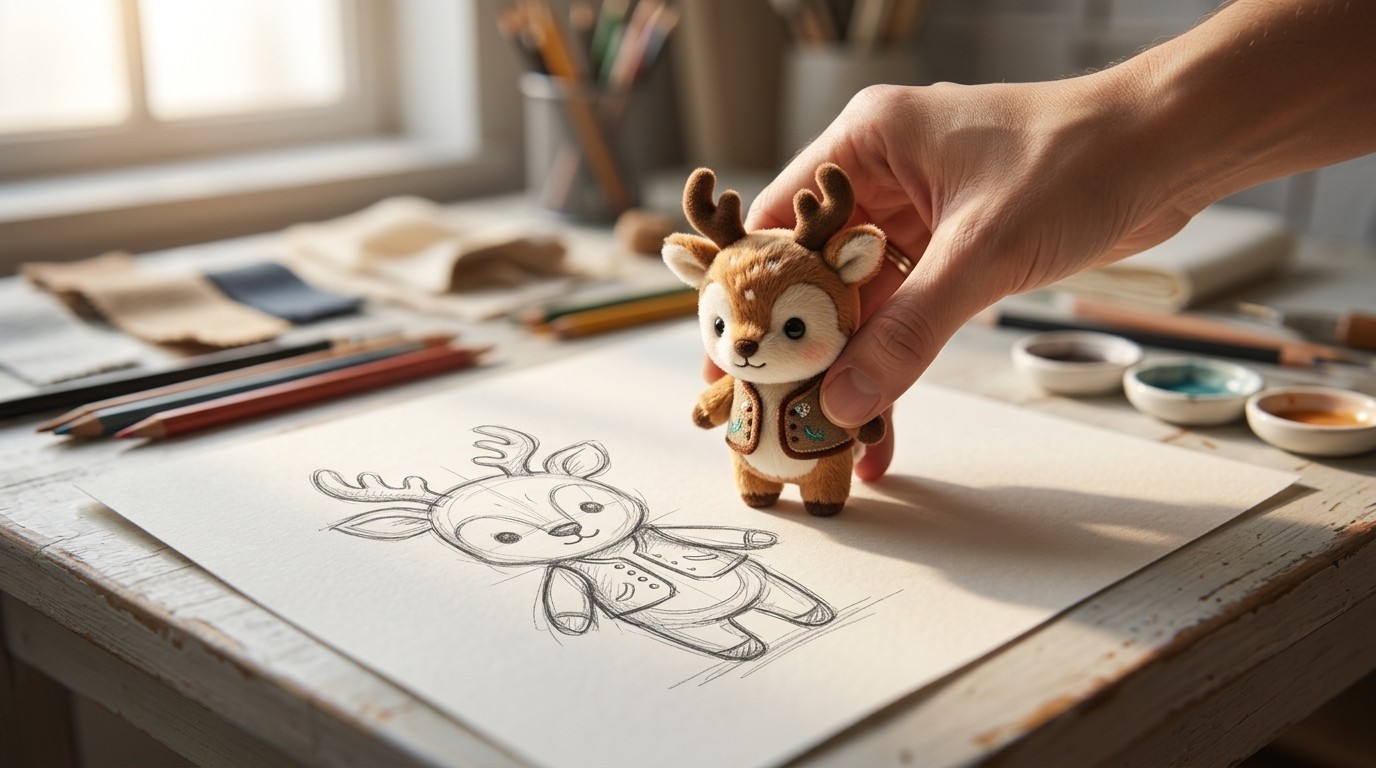
The traditional path from concept to physical prototype in custom plush manufacturing follows a defined sequence of steps, each of which adds time and cost to the overall timeline.
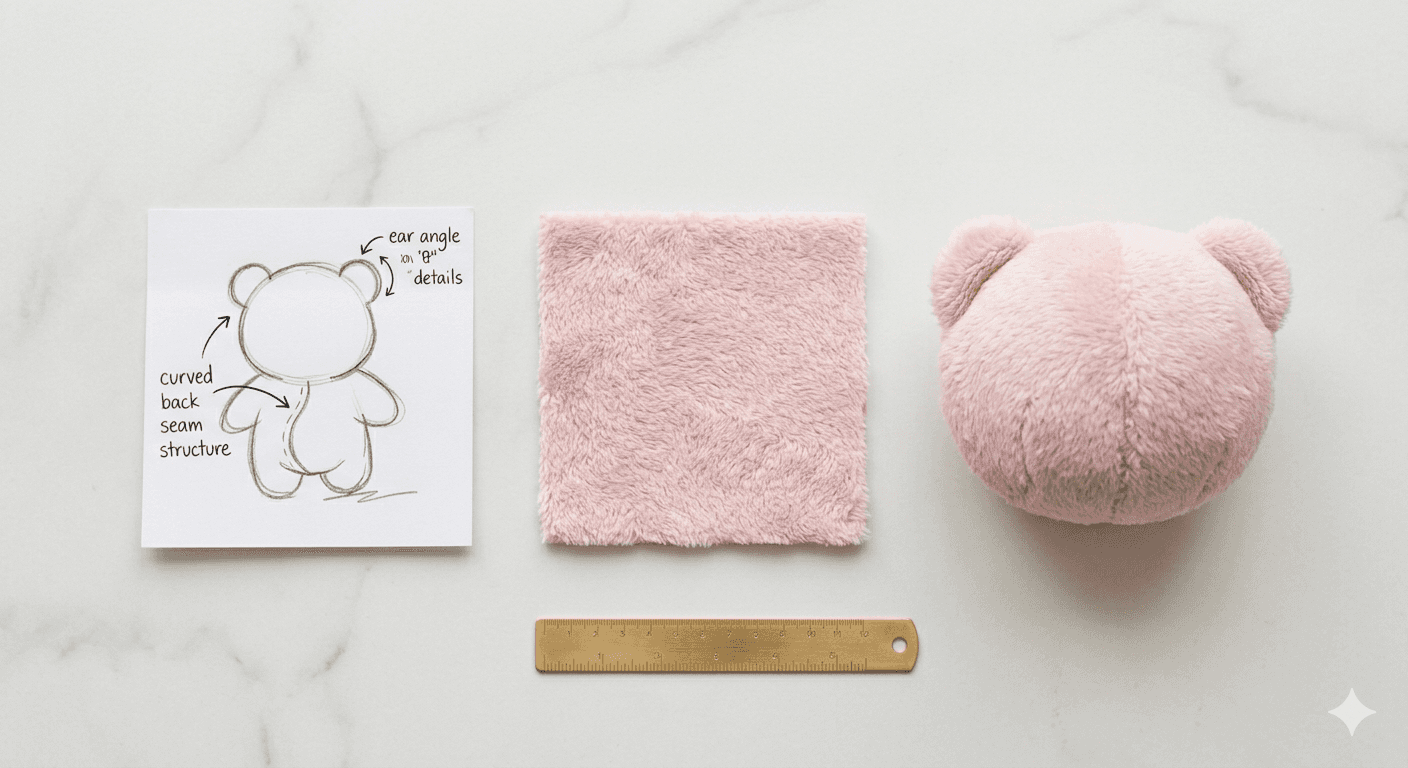
The process begins with a client brief, usually a written description of the character or object, accompanied by reference images if available. A designer or illustrator, either in-house or contracted, develops a series of concept sketches based on that brief. The client reviews the concepts, provides feedback, and the designer produces revised versions. This cycle continues until a direction is approved.
Once the concept is approved as an illustration, it goes to the manufacturer. The manufacturer's pattern-maker interprets the approved design and creates a paper pattern. A physical prototype is produced from that pattern and presented to the client for review. If the prototype does not match the illustration accurately enough, the client provides feedback, the pattern is adjusted, and a revised sample is produced.
The cost inputs in this process are significant. Freelance character illustrators typically charge between $300 and $1,500 for a character design project depending on complexity, the number of revision rounds included, and the level of technical detail in the final deliverable. In-house design resource costs more than this once salary and overhead are factored in. Physical sampling at Kedonia costs US$200 per round.
The time inputs are equally significant. A freelance illustrator typically takes one to three weeks to deliver a first concept and complete revision rounds to approval. Prototype production after design approval takes approximately five days at Kedonia plus any transit time for physical review. Revision rounds on the prototype add further time. The realistic total from first brief to approved sample, via the traditional route, is six to ten weeks.
HOW AI-ASSISTED PLUSH DESIGN WORKS
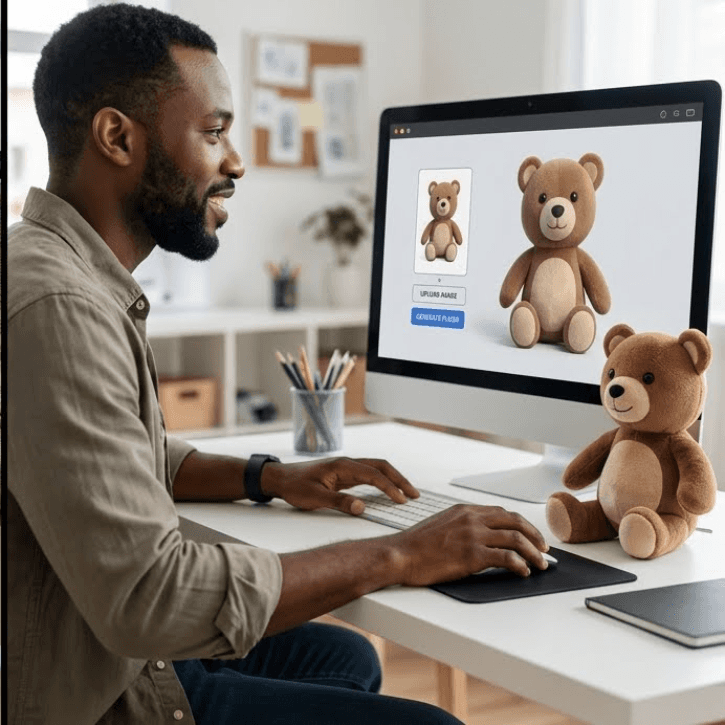
The AI-assisted path compresses the concept-to-brief stage dramatically. Instead of briefing a designer and waiting for illustrated concepts, you upload an existing image, a rough sketch, a phone doodle, a digital concept, a reference photograph, and the AI tool generates a realistic plush representation in under two minutes.
The output is a rendered image that shows the character or object in plush form with the textures, proportions, and material qualities of a real manufactured toy. This image serves as the shared visual reference for the production brief. The manufacturer receives both the original input image and the AI-generated concept, giving them a clearer understanding of the intended outcome than a written description alone provides.
The physical sampling process remains exactly the same. Pattern-making, prototype production, and the client review and approval cycle are unchanged. The AI tool does not produce a physical prototype. It produces a visual reference that makes the briefing process faster and the physical sampling process more accurate.
The cost of using Kedonia's AI tool is zero. There is no subscription, no per-use fee, and no commitment required to generate a concept. The cost of the physical sample remains US$200. The difference between the traditional and AI-assisted paths is the elimination of the design illustration cost, which typically runs $300 to $1,500, and the compression of the concept-to-brief timeline from one to three weeks down to hours.
SIDE-BY-SIDE COMPARISON
Concept to Brief Stage
Traditional path: One to three weeks for illustrator briefing, concept development, and revision rounds to approval. Cost: $300 to $1,500 for freelance illustration or equivalent in internal design time.
AI-assisted path: Under two minutes from image upload to plush concept. Cost: Free.
The AI-assisted path is faster by several weeks and cheaper by hundreds of dollars at this stage alone. For brands operating on tight seasonal timelines or responding to fast-moving trends, this compression is a material competitive advantage. For more context on how speed affects product relevance in the custom plush market, see kedonia.com/collection/why-plushies-are-taking-over-your-feed-and-your-heart.
Brief Quality and Manufacturer Communication
Traditional path: An approved illustration gives the manufacturer a high-quality visual reference. The quality of this reference depends on how well the illustrator has translated the client's intent and how clearly the illustration communicates the three-dimensional form of the intended toy.
AI-assisted path: The AI-generated plush concept directly represents the design in plush form rather than as a flat illustration, which means the manufacturer is looking at a reference that already reflects the material and structural context of plush manufacturing. This can reduce the interpretive gap between brief and prototype.
Both approaches produce useful design references. The difference is in how directly each reference communicates the intended plush-specific outcome.
Physical Sampling Stage
This stage is identical across both paths. Physical sampling at Kedonia costs US$200 per round and takes approximately five days. The approved sample becomes the quality standard for bulk production.
The only difference is that briefs built on clearer visual references, whether from a high-quality illustration or an AI-generated plush concept, tend to require fewer revision rounds. Fewer revision rounds means less additional sampling cost and a shorter overall timeline to approved sample.
Total Cost Comparison
Traditional path: $300 to $1,500 for design illustration, plus US$200 per sample round, plus any additional rounds required. Total concept-to-sample cost: typically $500 to $2,000 or more.
AI-assisted path: Free concept generation, plus US$200 per sample round, plus any additional rounds required. Total concept-to-sample cost: US$200 upward.
For independent creators and small brands working with limited budgets, the elimination of illustration costs makes the difference between a project that is financially viable and one that is not.
Accuracy and Design Fidelity
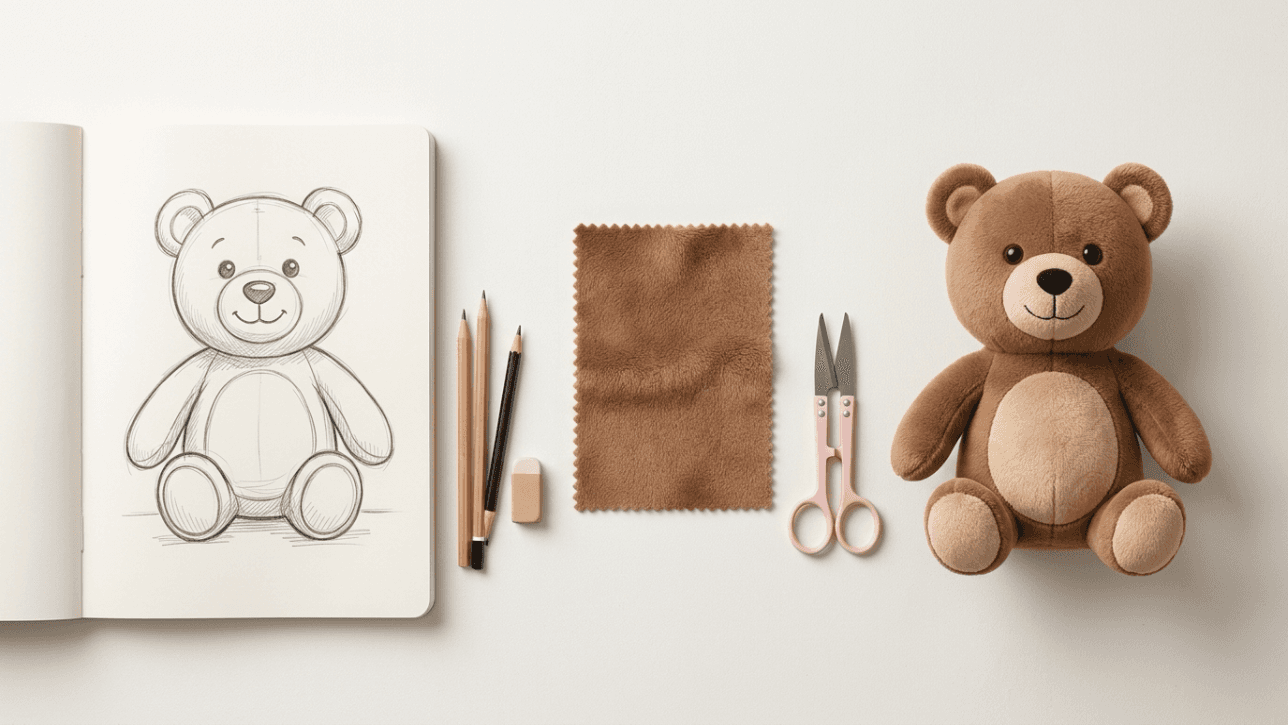
Traditional path: Accuracy depends heavily on the skill of the illustrator and how well the design translates from a flat illustration into a three-dimensional plush. Illustrators who specialise in plush character design understand construction constraints. General character illustrators may not, which can result in prototypes that look quite different from the approved artwork.
AI-assisted path: The AI tool is trained on plush-specific visual data and generates outputs that reflect how designs actually look in plush form. Complex or very detailed designs may be simplified in the AI output to reflect manufacturing constraints. This is a feature rather than a limitation, because it gives the brand early visibility into how their design will translate into a physically buildable product.
For highly complex or technically demanding designs, a combination of approaches works well. Use the AI tool for rapid concept exploration and early direction, then engage a specialist illustrator or work closely with the manufacturer's design team for the finalised brief.
WHICH APPROACH IS RIGHT FOR YOUR PROJECT
AI-assisted design is the right starting point for the majority of custom plush projects, particularly for independent creators, small brands, and first-time buyers who do not have a large design budget or existing design resources. It is also the right tool for brands that need to move quickly, for trend-responsive products, limited drops, or seasonal campaigns where the concept-to-production window is short.
Traditional design illustration adds value for projects where the character design is highly complex, where precise brand consistency across a range of products is essential, or where the brand already has a strong visual identity system that needs to be respected in detail. In these cases, a specialist plush character illustrator or the manufacturer's in-house design team adds expertise that the AI tool does not replace.
For most projects, the practical recommendation is to start with the AI tool at kedonia.com/ai to generate a concept quickly and evaluate whether the direction is worth pursuing before committing to either illustration costs or sampling costs. If the AI concept is close to what you want, it serves as the brief. If it identifies design challenges or simplification requirements, it gives you useful information before any manufacturing cost is incurred.
SEE HOW KEDONIA'S AI TOOL WORKS
Upload your sketch or concept at kedonia.com/ai and receive a realistic plush concept in under two minutes, at no cost. When you are ready to move to production, submit your brief at kedonia.com/process-and-pricing for a formal quote covering sampling, bulk pricing, and timeline. Contact the team directly at hello@kedonia.com for project-specific enquiries.
